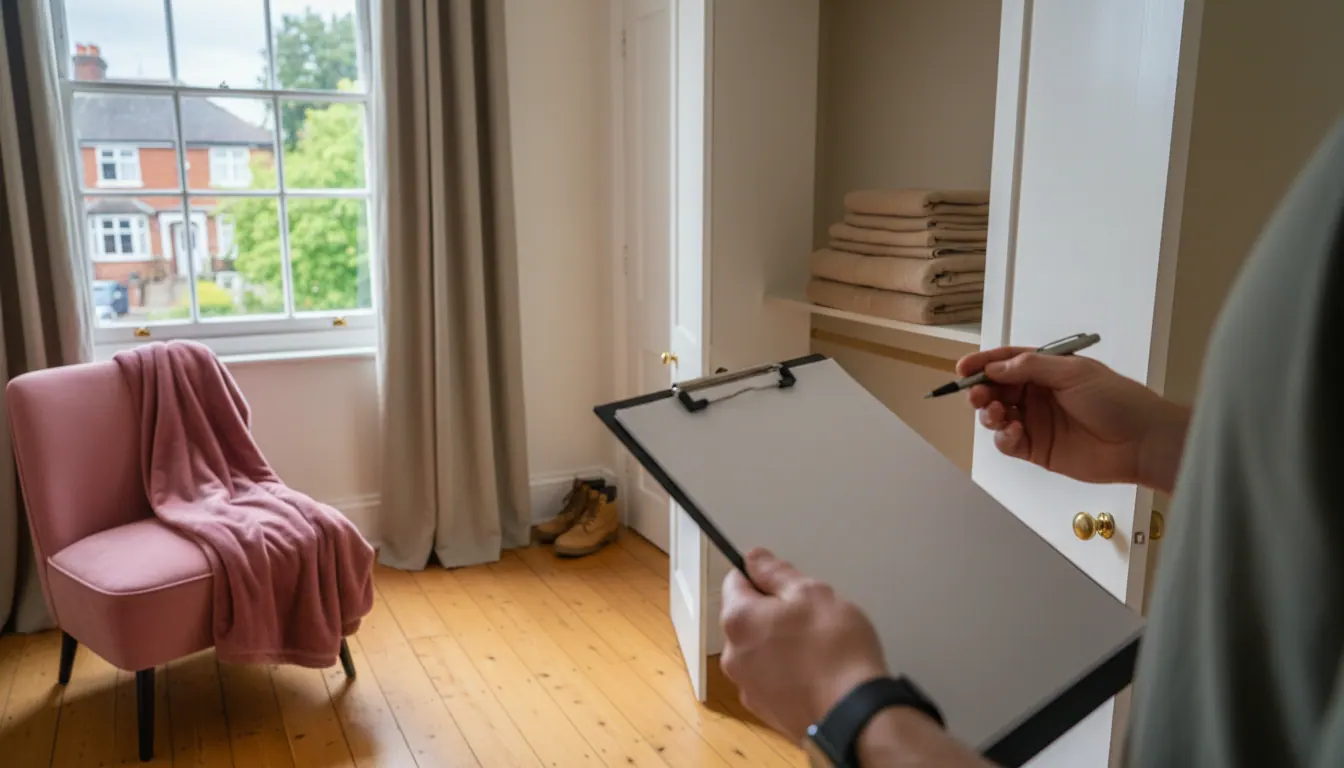
Why DIY Inventory Videos Fail Epsom Landlords: Real Examples & Cost Warnings
Self-managing in Epsom? Discover the most common DIY inventory mistakes local landlords make and why a professional report protects your deposit claims.

The DIY Inventory Trap Epsom Landlords Fall Into
A quick walk-round with a phone camera. A few typed notes on a Word document. Maybe a rough list of furniture scribbled before the tenant moves in. It feels like enough, and it saves money. Until it does not.
We see this regularly across Epsom and the surrounding areas. A landlord manages their own property, skips the professional inventory, and then faces a deposit dispute at the end of the tenancy with nothing solid to stand on. The deposit scheme adjudicator asks for evidence. The landlord has a blurry video and a one-page list with no condition notes. The tenant walks away with the full deposit. The landlord loses hundreds, sometimes thousands of pounds.
This article is about the specific mistakes we see Epsom landlords making with DIY inventories, and what a properly prepared report actually needs to contain.
Why Epsom Properties Have Particular Inventory Challenges
Epsom is a varied rental market. You have Victorian terraces close to the town centre, 1930s semis in Stoneleigh and Ewell, purpose-built flats near the station, and HMO rooms let to commuters and hospital staff from Epsom and St Helier. Each property type brings its own inventory challenges.
Victorian terraces often have original floorboards or engineered wood floors. These scratch. They mark. Without a detailed condition note at the start of the tenancy, any scratches at check-out become a word-against-word argument. We have seen landlords lose claims on exactly this because their DIY inventory simply said "wooden floors throughout" with no photographs or description of existing wear.
1930s semis frequently have older windows, slightly uneven plasterwork, and gardens that require specific condition descriptions. If you do not document the state of the lawn, the borders and the fencing at check-in, you cannot claim for garden neglect at the end.
Furnished HMOs and room lets to commuters bring their own complexity. Multiple tenants, shared spaces, and high turnover mean the inventory needs to be granular and timestamped. A DIY document rarely captures this adequately.
The Six Most Common DIY Inventory Mistakes We See
1. No photographs, or photographs without timestamps
A written description of condition is useful. Photographs are essential. But photographs only hold up if they are clearly dated and tied to a specific room and item. A folder of unnamed images saved on a personal phone does not satisfy a deposit scheme adjudicator. Our reports include timestamped photographs cross-referenced to every relevant item.
2. Vague condition language
"Good condition" means nothing without context. Is the carpet good for a five-year-old carpet, or good for a new one? Our reports use specific, consistent language: we describe the age where known, the type of wear present, any marks, stains or damage, and the location of each item. This precision is what makes the difference when a claim is contested.
3. Missing utility meter readings
Surprisingly common. A landlord forgets to record meter readings at check-in, and then a dispute arises about energy bills at the end of the tenancy. Meter readings should be in the inventory, signed off by both parties. We include these as standard.
4. No tenant signature at check-in
A landlord prepares a document, emails it to the tenant, and never gets a signature back. Without a tenant-signed check-in report, the document has limited evidential weight. We manage the check-in process so that the report is agreed and signed at the point of handover.
5. Forgetting communal areas and outbuildings
For Epsom properties with garages, loft access, outbuildings or shared areas, these spaces are frequently overlooked in a DIY inventory. If a tenant damages a garage floor or leaves items in a loft, you need documented evidence of the original condition to make a claim.
6. No professional check-out to compare against
Even landlords who do a reasonable check-in inventory often skip the check-out inspection or do it themselves in a rush. Without an independent check-out report that directly references the check-in, the comparison falls apart under scrutiny. Deposit scheme adjudicators expect a clear, item-by-item comparison from an independent party.
What Landlords Actually Win at Adjudication
Not every deposit dispute goes the landlord's way, and it is worth being honest about that. Adjudicators apply a fair wear and tear standard, which means you cannot claim for the natural deterioration of a property over time. A carpet that was already showing wear at check-in will not give you a strong claim at check-out, regardless of what the tenant has done.
What landlords do win, consistently, is claims that are backed by specific, dated, professional documentation. Damage beyond fair wear and tear, cleaning to a professional standard, missing items, and garden neglect are all winnable, provided the evidence is there.
We cover this in more detail in our article on Common Deposit Disputes in Epsom Rentals: What Landlords Actually Win.
What a Professional Report Actually Looks Like
Our reports are room-by-room, item-by-item, with photographs at every stage. We cover walls, ceilings, floors, fixtures, fittings, furniture, windows, doors, and any outdoor spaces. Every item has a condition note. Every photograph is timestamped and referenced.
For furnished properties, we list every item in every room, including soft furnishings, kitchen equipment, and any appliances, with serial numbers where relevant. For HMOs, we do this for each room individually, as well as for all shared spaces.
The report is produced quickly after the inspection, reviewed, and sent to both landlord and tenant. At check-out, we produce a comparative report that references the check-in directly, noting any changes, any damage, and any cleaning issues. This is the document that holds up under scrutiny.
Matt, a landlord who has worked with us for many years, puts it clearly:
I have been using Coopers Inventory Services for many years and I would never use anyone else. The reports are extremely thorough that they leave no room for discrepancy. Lisa and her team are super reliable, very friendly and professional at all times. The reports are always turned around quickly and I have always won claims because of good inventory and check out reports. 110 percent recommend!
That phrase, "leave no room for discrepancy", is exactly the point. A DIY inventory almost always leaves room for discrepancy. A thorough, independent report does not.
Mid-Term Inspections: The Step Landlords Skip
Many Epsom landlords do the check-in, then do nothing until the tenancy ends. A mid-term inspection, carried out professionally, gives you an early warning of any issues: unreported maintenance problems, changes in occupancy, or the beginnings of damage that is far cheaper to address early than to claim for at the end.
For landlords letting to commuters or hospital staff in room-by-room lets, mid-term inspections also help with compliance. High-turnover rooms need closer monitoring, and a documented mid-term visit provides a useful paper trail.
If you are managing properties across Epsom and the wider area, our article on Inventory Services Across Epsom, Oxted and Kenley: Multi-Area Coverage Explained explains how we cover the full area efficiently.
Frequently Asked Questions
Is a DIY inventory valid for a deposit dispute in the UK?
A DIY inventory is not automatically invalid, but it is far less likely to succeed at adjudication. Deposit scheme adjudicators look for independent, dated, detailed documentation with photographs. A self-prepared document, particularly one without a tenant signature or timestamped images, will often be given less weight than a professional report. In Epsom, where rental values are relatively high, the cost of a professional inventory is modest compared to the risk of losing a deposit claim.
What are the biggest red flags in a landlord's inventory process?
From what we see in Epsom and across Surrey, the most consistent red flags are: no photographs at all, vague condition descriptions, missing meter readings, no tenant signature at check-in, and no independent check-out report. Any one of these weakens your position significantly. Several together, and a deposit dispute becomes very difficult to win.
What happens if I do not provide an inventory at all?
Without any inventory, you have almost no basis for a deposit deduction claim. Deposit scheme rules require evidence of the property's condition at the start of the tenancy. If you cannot demonstrate what the property looked like when the tenant moved in, you cannot demonstrate that anything changed. This is the most costly DIY mistake of all, and unfortunately one we hear about after the fact more often than we would like.
Do Epsom letting agents require professional inventories?
Most reputable letting agents in and around Epsom either require or strongly recommend professional inventories as a condition of their managed service. If you are self-managing, you are not legally required to use a professional, but the practical consequences of not doing so are significant. Many self-managing landlords come to us after their first difficult deposit dispute, rather than before.
Get in Touch Before Your Next Tenancy Begins
The best time to sort an inventory is before the keys are handed over, not after a dispute has started. If you have a property in Epsom or the surrounding area and want to know how we can help, call us and we will talk you through what is involved. No pressure, just practical advice from a team that has been doing this for over 20 years.